Wednesday, December 25, 2013

Merry Christmas!

I wish you all merry Christmas and happy holidays! May these days be a peaceful time for you, a time for meeting with friends and family and sharing a good meal and forging new, happy memories!

As a Christmas gift to all my readers, I've made the Kindle edition of SPRINGTIME PLEASURES free until 29 December. (I know it's not exactly a holiday title, but I promise I'll do better next year!) Happy reading!




Tuesday, December 03, 2013

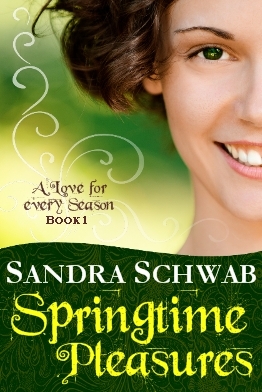
Let's celebrate! The Paperback edition of SPRINGTIME PLEASURES is out now!

I'm so thrilled to announce the release of the paperback edition of SPRINGTIME PLEASURES. The book is now available on all Amazon sites, and you can also buy it directly from CreateSpace. To celebrate the release I've set up a Goodreads giveaway where you can win one of five signed copies of the novel.


Goodreads Book Giveaway

Springtime Pleasures by Sandra Schwab

Springtime Pleasures

by Sandra Schwab

Giveaway ends December 31, 2013.
See the giveaway details at Goodreads.
Enter to win

Sunday, December 01, 2013

Giveaway!

Nikki Lynn Barrett is hosting a big Facebook giveaway. All you have to do to enter is to like the FB page of one or more of the authors participating. Good luck!


a Rafflecopter giveaway

Tuesday, November 19, 2013

An Interview with Janet Mullany

I'm excited to welcome fellow author Janet Mullany to my blog today. Janet has just released her latest historical romance A CERTAIN LATITUDE, and she has graciously agreed to answer a few questions about her book.

Please tell us a bit about yourself.
I'm the granddaughter of an Edwardian house servant on one side of the family, and on the other side my grandfather may have been Lenin's roomie in Switzerland (a family rumor that the family geneaologist is researching). I've been writing about eleven years now but I've always, and still do, read a lot. I think reading is essential to a writer.

As a backdrop for your latest release A CERTAIN LATITUDE, you've chosen the rather dark backdrop of slavery and abolitionist movement. What inspired this story?
A book--Bury the Chains, by Adam Hochschild, about the British abolitionist movement. I had only the very vaguest idea of what this involved, and I grew up and was educated in England! It's a fascinating part of history, a movement that involved men and women of all classes who felt that the slave trade--the most lucrative industry in the country, the mainstay of the economy--was wrong. The movement, which lasted over thirty years, ended when the Anti Slave Trade Act was passed in 1807. Emancipation came over three decades later. That's the history lesson. Great conflict! I originally intended to set the whole book in England, but the editor for whom I originally wrote it (it was published in 2007 as Forbidden Shores under the name of Jane Lockwood), insisted I set it in the Caribbean. I really didn't want to because the reality of slavery was appalling: the economic model was to work people to death. I wasn't that interested in an exotic setting--give me Quakers collecting signatures for petitions in the rain any time. I should also mention that A Certain Latitude is a rewrite of the original.

Tell us a little about the research you did for this project.
Having blown my original advance on downspouts, gutters, a new washer and dryer, and the MC bill, as one does, I relied on the internet. Some amazing sites I discovered were the Museum of Antigua and Barbuda, the BBC's resources on abolition, and Brycchan Carey's site. I also became interested in the black community of Georgian England, which continues to fascinate me. Although most slaves were worked to death in the sugar industry if they survived the voyage out, some ended up in England, and from Roman times England has always had a black community. I visited Bristol and its museums--possibly that city and Liverpool were the more famous slave ports, but in fact London was the biggest. And by the way, the movie Amazing Grace was bizarrely simplistic, and twisted historical facts like only the movie business can! For life aboard a ship, most of my research comes from The Last Grain Race by Eric Newby, his account of life as a crewman sailing from Dublin to Australia in 1939.

In one scene, your heroine throws her spinster's cap and her gray wooly stockings into the ocean. Tell us more about Clarissa Onslowe. What kind of woman is she?

She's someone who has nothing to lose. It makes her reckless and very courageous, but also capable of making some unwise choices. She's been cast out by her family after having been caught out in an affair, something clergyman's daughters just didn't do, and was exiled as a housekeeper to an elderly relative. She's now seeking to redeem herself by going to the sugar island as a governess, but intending to write and publish a book on the conditions of female slaves, hoping that then her family, also abolitionists, will accept her again.

The heat level in your historicals is typically rather high. :-) Tell us how you manage to balance the erotic content and the historical conventions.

I think that's one of the most interesting and challenging parts of writing historicals. You have to work with the reality of people never getting entirely naked for sex and also believing that any activity without a fighting chance of conception was a mortal sin (if that's what you mean by the historical conventions?) and if I stuck with that it could be a fairly yawnworthy book. On the other hand dodgy contraception, ignorance and guilt are still with us, so possibly not much has changed.  There's lots of undressing in this book! I love the textures and fabrics of that period.

Which authors have inspired you?
Jane Austen. It always comes back to her. I've also learned a lot from Pam Rosenthal/Molly Weatherfield, who is one of the smartest writers out there, particularly on writing erotic material. Georgette Heyer was a great influence on me when I first started writing but I can't bear to read her now, and I'm very relieved she didn't know about London's black population in the Regency.


Janet at Chawton House in England

What are you working on right now?
I'm writing about Allen and Clarissa seven years after the end of A Certain Latitude. It's a book about the seven year itch, what you do after devoting your life to a cause that has succeeded, and whether it's possible to stop yourself falling in love. It's called A Certain Proposition and I hope it will be out in about three months. When I was (re)writing A Certain Latitude I found myself wondering what would happen to them after their rather adventurous time together.

What was your favourite book of 2013?

Longbourn by Jo Baker, which is P&P from the servants' point of view. I'm wild with envy that I didn't have the idea first or the writing chops for it since I'm fascinated by servants in the Georgian/Regency period.

Thanks so much, Janet!
____________________________________________

Janet Mullany grew up in England and has worked as an archaeologist, performing arts administrator, classical music radio announcer, bookseller, and editor, and unexpectedly became a writer eleven years ago. She lives outside Washington, DC, where she reads voraciously and teaches a cat manners.

You can visit her online at www.JanetMullany.com

Or find her on Facebook and Twitter.

A CERTAIN LATITUDE is now available from Amazon.


Wednesday, November 13, 2013

Home for the Holidays Hop - German Holiday Cookies


German Holiday Cookies: Spekulatius*

I've always been a huge fan of Spekulatius, German holiday cookies, but I've found the following recipe only last year -- and it has already become one of my favourite holiday cookies! Not the least because this receipe is just perfect for cookie stamps. :-) (If you don't have a cookie stamp, never fear: the cookies taste fantastic with or without stamped motif)


You will need:
  • 250 g / 9 oz plain flour
  • 1/2 teaspoon baking powder
  • 50 g / 2 oz skinned and ground almonds
  • 100 g / 3,5 oz softened butter
  • 100 g / 3,5 oz brown sugar
  • 2 tablespoons vanilla sugar
  • 1 teaspoon cinnamon
  • 1/2 teaspoon ground ginger
  • a pinch each of ground cloves, nutmeg, coriander, cardamon
  • a pinch of salt
  • 1 egg
  • 50 g / 2 oz flaked almonds
Mix the flour with the baking powder and the ground almonds. Cream together the butter with the sugar, the vanilla sugar, the spices, and the salt. Add the egg, mix together, then add the flour mixture and quickly mix in.

Wrap the dough in cling film and put it in the fridge for about 1 hour.

Pre-heat the oven to 200° C / 392° F (fan-assisted oven: 180° C / 356° F).

Line two baking trays with baking paper and sprinkle the flaked almonds onto the paper.

Roll out the dough on a floured surface about 4 mm thick. Cut in rectangles. OR run wild with your cookie stamp(s) and your cookie cutters. :-)

Place the cookies onto the baking trays and bake for about 12 minutes until golden brown. Place the cookies onto a baking rack until cool, then store them in a pretty tin. (They developed their full taste only after a few days.)


Now you have the cookies, it's time to grab a cup of tea (or coffee) (or hot cocoa) and snuggle up on your couch with a nice book! And since you're warm and comfy, what could be better than a book partly set in the stark, bleak landscape of the wintry fenlands?

When BEWITCHED was first released, Kathe Robin from RT Book Reviews called the novel a "captivating tale of a spell gone wrong, a love potion gone right, deceit, revenge, black magic and redemption."


Sweet passion ...

After a magical mishap that turned her uncle’s house blue, Miss Amelia Bourne was stripped of her powers and sent to London in order to be introduced into polite society—and to find a suitable husband. Handsome, rakish Sebastian “Fox” Stapleton was all that and more. He was her true love. Wasn’t he?

... or the bitter taste of deceit?

At Rawdon Park, the country estate of the Stapletons, Amy began to wonder. Several inexplicable events suggested that one sip of bitter punch had changed her life forever—that this love, this lust, was nothing but an illusion. She and Fox were pawns in some mysterious game, and black magic had followed them out of Town. Without her powers, would she be strong enough to battle those dark forces and win? And would she be able to claim her heart’s true desire? Magic potion or no, what she felt for Fox was a spell that could never be broken.


~~~~~~~~~~

Do you have a favourite kind of holiday cookie or any other favourite holiday food?

The giveaway has now ended.

For a chance to win the Grand Prize in the Home for the Holidays Hop
leave a comment with your e-mail address here on this blog.


Visit the Event Page for a list of all stops
(Each blog where you visit and leave a comment
means another entry in the drawing!)


But that's not all!

For a chance to win an additional goodie bag
full of German Christmas goodies,
(think Christmas chocolate!)

subscribe to my newsletter


* The recipe is based on the Spekulatius recipe from the book Lieblings-Weihnachtsplätzchen by GU. The original recipe can be found online here.

Tuesday, November 12, 2013

NaNoWriMo - Day 12 - General Despair


When I signed up for NaNoWriMo I knew that the chances were high I would become completely stressed out at one point or another. And I knew if that happened, it would be really bad (because for various reasons I'm not dealing with stress very well these days).

Well, guess what! I hit this point a lot earlier than I expected, namely on Day 10 of NaNoWriMo. Uh-oh. Lying rolled up on the floor and sucking my thumb would have been one possibility to deal with the situation. However, the floor is rather hard (no carpet) (well...I could have bought a carpet, I suppose) and the whole thing might have worried my family a tiny little bit (not to speak of the doggie sister! she might have been traumatised by seeing me lying on the floor, sucking my thumb!) (ah, well, probably not; most likely, she would have just licked my face...and then my ear...and then the inside of my ear...ugh!).

So instead of the floor-option, I took deep breath (figuratively and literally) and a step back (just figuratively) and thought about what I wanted from NaNoWriMo.

50,000 words, no matter how bad?

No, actually not.

I know that on the NaNo forums and in blog posts about NaNoWriMo you hear a lot about how the first draft is always crap. Well, here's the thing: that's simply not true. Some authors produce a first draft in a very short time and then go through several rewrites -- and this works absolutely fine for them. Yet it just doesn't work for me: I'm a slow writer, but to make up for that, my first drafts normally just need some tweaking instead of major rewrites.

So I've decided that instead of stressing myself out over my word count for NaNoWriMo, I will simply proceed at my own pace and try to write the best story I can. Moreover, I've found that stories sometimes need a bit of space to breathe during the writing process, especially when they are very emotionally charged. When I write such stories, I feel wrung out after each writing session. Well, and guess what kind of story I've picked for my NaNoWriMo project!

To illustrate my point, I'll leave you with a snippet from a scene I wrote this weekend. It's a chance meeting between the hero and the heroine (who know each other from their youth - it's a second-chance-at-love story):
“It was very good of you to play the piano for us last night,” he said gently.
She threw him a quick glance as if wanting to gauge his intentions. “Not at all,” she said, hiding her face once more. “I wouldn’t have been able to dance anyway, what with being still in mourning.”
 

“Ah yes,” he gravely replied. “My condolences at your loss.”
 

Her head whipped around and glittering brown eyes bore into his. “You shouldn’t—“ she began almost angrily, but then bit her lip. For whatever reason, new streaks of red slashed across her cheeks.
She glanced away, yet perhaps driven by that same force that kept him rooted to the spot, she sought his gaze again after a few heartbeats. “You know it was no love match,” she finally said quietly. “I do not—“ She stopped, chewed on her lip. “I do not miss him,” she whispered. She looked across the shop, presenting him with her profile.
 

How thin her face had become, almost haggard.

“Did you ever meet him?” she asked softly. “He was rather ... old.”
 

“How old?” he felt compelled to ask, his voice gruff.
She bowed her head. “More than thirty years my senior.”

Saturday, November 09, 2013

NaNoWriMo - Day 9: Setting the Scene


The setting has always been an integral part of my books, and over the years many reviewers have remarked upon the descriptions of the setting in my novels. When my debut novel The Lily Brand came out in 2005, Robyn Roberts from Once Upon a Romance remarked:
Ms. Schwab gave such detailed descriptions of the estates, gardens and people that I felt as if I knew them myself.
And when Castle of the Wolf was published in 2007, Sandra Marlow from the Historical Romance Club wrote in her review that
Ms. Schwab's writing has a flow that pulls you into her stories so subtly that you forget you're just reading a book instead of actually interacting with her characters. I finally have visited the Black Forest of Germany.

Truly, there is no greater compliment for a writer than "I was right there with the characters." (Well, "I stayed up all night to read this book" isn't too bad either! *g*) I've always had this particular knack for descriptions - indeed, even when everything else about my writing was pretty much crap, I could pull of descriptions of the setting.

But how do you do it without overwhelming your reader with pages after pages of endless descriptions?

I tend to think of describing the setting as layering the scene, and I was reminded of this when I was working on one particular scene of my NaNoWriMo project this week. So I thought I'd share my process with you. Here's what I started out with. This is the beginning of the scene that introduces the hero:
Alex entered the City through Temple Bar and was immediately enveloped by the hustle and bustle of Fleet Street.

Well... Nice, but a bit bland, isn't it? It doesn't evoke any specific images, instead what you get is a rather blurred view of a busy street. However, for historical fiction, I think it's very important to take your reader into the scene and let him catch glimpses of that faraway, long-ago world your characters inhabit. So, let's add a few things, shall we?

I like working with visual cues - that makes it easier for me to get a feeling for the setting and to describe things - so I started by doing a Google search for images of nineteenth-century street life. I also searched for period maps.


Depending on your setting, you can really find the most amazing things online, ranging from drawings, cartoons, and photographs of street scenes to beautifully detailed maps and descriptions in old magazines. Now that we've collected all this info, let's work on our sentence and let's start with Temple Bar (the online search yielded that it once separated the Strand from Fleet Street and was used in the olden days to display the heads of executed traitors):
Alex entered the City through Temple Bar, which had once been crowned by the heads of executed traitors. The only sightless heads staring down from it now where the two Charleses on their pedestals high up above the bustling street. Arrogantly, their stony eyes watched watched the efforts of carts, carriages, and pedestrians to press through the gates.
Much better, isn't it? Now you get a glimpse of that construction the hero is passing through, and you also have this nice contrast between the immobile statues of Temple Bar and the movements in the street. Fleet Street was one of the main thoroughfares through the City of London, and as such it was prone to traffic jams. In one of Gustave Doré's illustrations of London in the 1870s, you can see Ludgate Hill and rather horrid press of traffic:


In the middle of the foreground you can just about make out a horse-drawn omnibus, with passengers sitting on the roof, while in the background at the right a flock of sheep blocks the street.

A flock of sheep??? Now wouldn't this be something! (If you've read any of my novels, you know that I'm often attracted to the weird and slightly ludicrous.... *g*) So, let's give our readers some glimpses of what the "hustle and bustle" in the sentence from which we started out, actually refers to. And let's add some noise to involve more senses:
A bleating flock of sheep blocked the path of an omnibus, and the driver swore a blue streak, waving his fist at the woolly [hooligans]. Passengers were hanging out of the windows, complaining about the delay, while behind the bus along line of carriages had become stuck. A hearse, going in the opposite direction to the Strand, tried to pass by and nearly ran down a boardman, sandwiched between advertisements of the latest fabric cleaner and hairwater.
Boardmen carrying advertisements were part of the fleet of poor people you could see milling about the streets of London. In 1870s photographer John Thomson ventured out to take pictures of these people, of the street sellers and beggars and chimney sweeps and shoe-blacks. Several of his photographs are featured in the book Dickens's Victorian London and you can see examples of his work here. I've added the boardman advertising Renovo and the shoe-black to my scene as well as another kind of street seller featured in Henry Mayhew's The London Poor. Oh, and I've also added smells (in the early Victorian Age, even several of the better areas in London had problems with their sewers):
The din reminded Alex of an Eastern bazaar, but as for the smell—
He wrinkled his nose.
It would appear that today Fleet Street was permeated by the poignant aroma of l'eau de sewer.
 

And that’s what an Englishman calls civilisation, he thought wryly. He stepped around a shoeblack, who huddled against a wall covered in advertising posters.
 

In the rise and flow of vehicles and pedestrians from all walks of life, nobody paid much attention to the tall, blond man, his face deeply tanned by Eastern suns. But then, how could they have known that here walked Alexander Crenshaw, a man whose adventures in America and in the Far East many a reader had followed avidly? Indeed, to his own surprise, Alex had found that in the seven years he had spent away from England, he had become something of a celebrity. Society hostesses vied for his attention, invited him to their balls and parties, and men were eager to talk to him, to invite him to their clubs.
 

A great bother, all of it, really, yet if it ultimately helped to bring in additional funds for Layard’s excavations, Alex would not complain. He owed the man a lot, and the least he could do was to properly prepare for Layard’s arrival in a few months’ time [...].
 

Further down the street, across from St Dunstan’s, a muffin-man ran his bell vigorously and proclaimed his ware. As Alex walked past him, a whiff of warm muffins and crumpets rose from the street seller’s basket to tickle Alex’s nostrils.

See? Isn't this so much better than "Alex entered the City through Temple Bar and was immediately enveloped in the hustle and bustle of Fleet Street"? While our starting sentence was rather bland and gave the reader only the vaguest impression of this Victorian scene, in the fleshed-out paragraphs the scene comes to life, and you allow your reader to experience the sights and sounds and smells of a Victorian street scene


Thursday, November 07, 2013

NaNoWriMo - Day 7: Food for Thought (and for Your Characters!)


I love including references to food in my novels - after all I love eating (who doesn't?) (okay, well, some people don't). I have several research books on food (as an author one has to be prepared for everything and anything!):


  • Kate Colquhoun, TASTE: THE STORY OF BRITAIN THROUGH ITS COOKING
  • Bruno Laurioux, TAFELFREUDEN IM MITTELALTER (about food in the Middle Ages; I've had this book for 14 years and have never once used it, but you never know!)
  • Maggie Black and Deirdre Le Faye, THE JANE AUSTEN COOKBOOK
  • Kristin Olson, COOKING WITH JANE AUSTEN
  • Jane Pettigrew, A SOCIAL HISTORY OF TEA
  • Claire Masset, TEA AND TEA DRINKING (Shire Library book = always good, with many, many illustrations!)
  • Ivan Day, ICE CREAM (another Shire Library book)
  • Krista D. Ball, WHAT KINGS ATE AND WIZARDS DRANK: A FANTASY LOVER'S FOOD GUIDE (also quite interesting for the writer of historical fiction; includes such gems as: "My eighty-three-year old father has been hunting most of his life and he offers his advice to the hero wanting to hunt rabbits while being chased by orcs: go hungry.")
  • Marcus Gavius Apicius, DE RE COQUINARIA (cookbook in Latin and German; have never used it either, but you never know!)
  • MRS BEETON'S BOOK OF HOUSEHOLD MANAGEMENT (two different editions, both sadly lacking the colour plates - hmph)
  • Gervase Markham, THE WELL-KEPT KITCHEN
  • William Verrall, RECIPES FROM THE WHITE HART INN
  • Agnes Jekyll, A LITTLE DINNER BEFORE THE PLAY
  • Hannah Glasse, EVERLASTING SYLLABUB AND THE ART OF CARVING
  • Charles Lamb, A DISSERTATION UPON ROAST PIG & OTHER ESSAYS
In addition, I also own two books on the history of chocolate, but they are both on top of one of my kitchen cabinets (aka far away from my desk and my computer, and I'm really lazy right now and don't want to get up and walk to the kitchen and climb onto a chair and fetch the books)

(Goodness! I do own a lot of books on food, don't I? I didn't know how many until I've just hunted them down in the research section of my home library.)

I also own various other books on tea-ware, on china (various books on china, in fact), and a history of Burleigh. Moreover, food is also mentioned in several other research books that are not specifically about food. (Survival guides are particularly good if you want to learn about skinning fish.) (Why would you want to learn about skinning fish, you ask? Oh, I don't know. Perhaps in one of your books you have a  heroine who feels the urgent need to talk about skinning fish while dancing with the hero at a high-society ball. Just saying...)

The internet is also a wonderful place for doing research on food in the past - try looking on Google Books for old cookbooks! Personally, I really like Frederick Nutt's THE COMPLETE CONFECTIONER. Bergamot drops for your hero? Nutt has 'em!

In the current chapter of my NaNoWriMo project, my heroine is attending a dinner party, so of course, I had to include at least some throw-away references to the food that is served at this party. And because I knew that Mrs Beeton is unbeatable when it comes to visual guides on how to present food in the nineteenth century, I did a search on Mrs Beeton and fowl and ended up with the picture above. Isn't it splendid? Especially the way in which the roast partridges and pigeons and fowl are holding up their little roast feet! That was just too good not to use:
Fran stared at the roast pigeons on their splendid silver platter in the middle of the table, daintily stretching their little roast legs up in the air, and thought she might be sick.

Wednesday, November 06, 2013

NaNoWriMo - Day 6: Inspiration


And yet another way to get inspired for NaNoWriMo and to get past the dreaded mid-book blues: receiving a truly wonderful review for the novel you've just released! (Woohooo!)

Today I found the November edition of the German magazine LoveLetter in the mail. It not only includes an article by yours truly, but also a review of SPRINGTIME PLEASURES. It's fair to say that the reviewer loved the book: she compares the banter between the protagonists and the humour of SPRINGTIME PLEASURES to those in Hollywood comedies and calls the novel a "small jewel of a story".

Battling with the Muse has suddenly become much less of a hardship. :-)

Tuesday, November 05, 2013

NaNoWriMo - Day 5: Abysmal

Words written today: 432 (squeezed in during a 35-minute lunch break)

Argh!

But at least I've managed to torment my heroine for a bit (my heroine, the Dowager Lady Clifford, has just arrived at a dinner party & is announced by a footman) (excerpt that follows is rough - just so it can't be said I haven't warned you!):

The party, Frances saw with relief, was indeed a small one. There were no more than ten or twelve people present. In one corner of the room a small gaggle had formed around a tall, blond man, who stood with his back to the door.
Frances frowned. A small shiver of foreboding slid down her spine.

“—and the Dowager Lady Clifford.”


The man turned.


He was older, of course, and his face deeply tanned by the Eastern sun. There were new lines in his face that had not been there seven years ago.


Their gazes met and clung—for one endless, awful, wonderful moment.


Her breathing stopped, perhaps even her heartbeat. Oh Alex, she thought. Alex…
But the moment passed, and his eyes slid away, and he gave no sign that he knew her at all.

Monday, November 04, 2013

NaNoWriMo - Day 4: What to do when you're stuck


Typically, when I reach Chapter 3 or 4 of any new project, the dreaded mid-book blues hits: that feeling that your story is crap, that it's the worst thing ever written in the whole history of mankind, and where the heck do you want to go from here anyway?

Apparently, this is a perfectly normal process a lot of writers go through and doesn't necessarily mean that your story is really so bad that reading it would have killed the dinosaurs (if they had been able to read, that is). The trick is to overcome this feeling and to continue writing (because, let's face it, curling up into a ball and sucking your thumb helps neither with your story nor with your word count -- not to mention that it makes you look rather ridiculous, too).

So what do you do when the mid-book blues hits? Here are a few ideas:
  • If you haven't yet done an outline of your novel, do it now. This might help you to recognise themes and motifs in your novel (I'll do a separate post on my method of outlining soon.)
  • Write a scene from later in the book (aka the patchwork approach to writing a novel)
  • If you have a writing buddy, phone her or e-mail her and talk about your project. A fresh pair of eyes might give you a new perspective on your novel.
  • Do a mock-up cover for your book - this typically gets me really, really excited about a new project.
  • Do some (light! at least during NaNoWriMo) background research on your setting -- this might give you ideas for new scenes or ideas how to expand existing scenes
  • Go for a walk to "air" your brain. :-)
  • What a film to let other people's creativity inspire you. (I find Studio Ghibli films extremely inspiring. Watching those beautiful animated films always makes me want to sit down and write and create something myself.)
Happy writing!


Sunday, November 03, 2013

NaNoWriMo - Day 3: Naming Your Characters


Coming up with names for your characters can be tricky, especially when you are writing historical fiction. After all, you wouldn't want to give your nineteenth-century British heroine a name like Charlene (which is a twentieth-century name that is mainly used in North America and Australia), would you? But never fear: there are tools to help you!

A dictionary of first names is always a good investment. I have A Concise Dictionary of First Names by Patrick Hanks and Flavia Hodges from Oxford University Press, which I love because it gives you a short explanation and history for each name, e.g.
Frances: Feminine form of Francis. In the 16th century the two spellings were used indiscriminately for both sexes, the distinction in spelling not being established until the 17th century.
Short form: Fran
Pet form: Franny

These days, however, I mostly use another book to find names for my characters, namely an 1833 edition of Debrett's Peerage, which is basically an index of all the peers of the United Kingdom. Apart from titles and names, the book also offers some information about the family history: 
DUDLEY RYDER, Earl of HARROWBY, Viscount Sandon, co. Stafford, Lord Harrowby, of Harrowby, co. Lincoln, High Steward of Tiverton, D.C.L., F.A.S.; born 22 Dec. 1762; succeeded his father, Nathaniel, the late lord, 20 June 1803;  created, 19 July 1809, Viscount Sandon and Earl of Harrowby; married, July 1795, Susan Levison-Gower, da. of Granville, 1st marquess of Stafford, K.G., (by Susan Stuart, da. of Alexander, 7th earl of Galloway), and has issue, - 1. SUSAN, b. 20 June 1796, m., June 1817, Hugh, viscount Ebrington, eldest son of the earl of Fortescue, and d. 30 July 1827; - 2. DUDLEY, viscount Sandon, b. 7 May 1797, M.P. for Liverpool; m. at Berne, 15 Sept. 1823, Frances, da. of John, 1st marquess of Bute, and has issue, 1. Frances, b. Sept 1824; 2. Dudley, b. 5 Jan. 1828 [...]
 As you can see in the image above, people would add handwritten notes with additional information, for example about births and deaths: the nineteenth-century owner of my copy of Debrett's has added a "d" for died or dead in front of Susan Levison-Gower's name. Thus, Debrett's also has a way of confronting you with the harsher realities of life in the nineteenth-century: even in noble families many children didn't survive past infancy; mothers died in childbed, young men were lost at sea.

What you also find is that fancy names were rather uncommon (at least among the upper classes). Men were given traditional English names such as William, John, George, Peter, Thomas, Henry, James, Charles, Robert, and sometimes Augustus or Nathaniel. A greater variation appeared to have existed when it came to women's names: the most common of those were names like Mary, Maria, Emma, Caroline, Catherine, Anne, Sophia, Elizabeth, Susan(na), Jane, Charlotte, Henrietta, Louisa. But you can also find more exotic names such as Urania-Annabella (poor child) (in the Wallop family, Urania seems to have been a popular name as it pops up in several generations) or Meliora-Emily.

Moreover, I use Debrett's for inspiration for last names and titles. Thus the entry I cited above inspired the name of a secondary character in my NaNoWriMo project: my heroine's brother-in-law is called Nathaniel Ryder.


Saturday, November 02, 2013

NaNoWriMo - Day 2: NaNoWriMo in Pictures


Day 1: 6:30 a.m.
NaNoWriMo starts


Day 1: 10:30 a.m.:
Successfully completed first leg of the challenge 


Day 2: 2:30 p.m.:
Bad planning: I spent the morning doing research
because I hate it when it don't know where exactly my characters are 


Day 2: 4:50 p.m.
Things are proceeding slowly today on account of many descriptive passages.
Probably too many descriptions. We'll see.

Friday, November 01, 2013

Springtime Pleasures & NaNoWriMo 13 - Day 1


I do apologise: I've been a bad blogger. *hangs her head in shame* I really do need to get back the hang of blogging on a regular basis. I mean, I didn't even announce the publication of SPRINGTIME PLEASURES here. Argh! *head desk*

Yes, SPRINGTIME PLEASURES has come out and has already garnered some very nice reviews. The German LoveLetter magazine called it "a small jewel" and Mel from bookworm2bookworm wrote about the novel:
"If I was given one word to describe ‘Springtime Pleasures’ I would choose ‘cute’, but I’m so glad not to have to choose only one word because this is one of those books that will have you smile long after you’re done reading it."
 "Cute" was also how Carole Rae described the story:
"Overall, this was a cute and fun and simply adorable. I simply loved the added letters. It really added a special-ness to it. I'm also so glad that Sandra Schwab made the HEA between Charlie and Griff a little harder to obtain. I shall recommend this to those that love HRs and for those looking for a book that will make them smile."

Oh, I LOVE making my readers smile! :-)

You can buy the ebook online from Amazon (a print edition will follow in a few days' time), or you can enter one of several giveaways:


Good luck!

~~~

In other news: I'm taking part in NaNoWriMo 2013, i.e., National Novel Writing Month, when thousands of writers from all around the world aim to write a novel of 50,000 words in 30 days. I start off my first NaNoWriMo as a NaNo Rebel because I'm not exactly writing a novel, but something else. A secret project. Shhhhh.

You can find my NaNo profile here - if you're joining the NaNo madness, please feel free to add me as your Writing Buddy!

Today started quite well: so far I've written 2609 words and have already made my heroine almost cry. I will proceed to ruin my hero's day tomorrow. :-)

Here's a snippet from today's chapters (please remember that this is a raw, very raw, first draft!):
"Have you heard? Devil's back," said the men in the alehouses of London, with whom he had drunk and gambled and sometimes fought, ugly, brutal tavern brawls, not at all fitting for one of the house of Crenshaw. In the Cider Cellar, which could boast to have been his favourite haunt, they sang a raucous song in his honour, toasting the man who would laugh Satan himself in the face.

Stay tuned for further NaNoWriMo updates!

Wednesday, October 09, 2013

The Appeal of the Gothic - A Guest Blog on Bookish


Today, I'm on Evie Seo's blog Bookish, where I'm doing a guest post on "The Appeal of the Gothic": it's all about fake ruins, fake castles, and other gothic flights of fancy.

And as you can see from this lovely header Evie created for my post, it's warm-up for the re-launch of CASTLE OF THE WOLF next week! (I'm so excited about this!)

So please join me at Bookish, and don't forget to enter the giveaway!

Saturday, October 05, 2013

A Saturday in the Life of an Indie Author

Today's accomplishment's so far: Bought and downloaded Jutoh.

Plan for the rest of the day:
1) Run final spell check over "Springtime Pleasures"
1b) Make (& drink) cup of tea.

2) Try to get internet connection on new notebook
2b) Make (& drink) another cup of tea.
2c) If things get desperate, eat some chocolate. Also, don't cry.

3) Install Jutoh
3b) Make (& drink) more tea.
3c) Eat some chocolate as reward.

4) Build ebook
4b) Tea.
4c) More chocolate.

Friday, October 04, 2013

Teaser Friday


Just a little more than a week before Springtime Pleasures will be released! I'm so excited, and I can't wait to share this story with you!

For now, I present to you the following snippet, in which Carlotta (Charlie), my heroine, and her best friend Emma-Louise discuss the merits of the hero. Enjoy!

“The drive with Lord Chanderley was pleasant. Very pleasant, truth to be told.” Charlie looked up at her friend. “I wish you could meet him one day. He is so handsome. Indeed, I should say he is the most handsome man in all of London!” She smiled dreamily. “He can make his eyebrows mesh. Like this—” She curled her forehead, imitating Chanderley’s frown.

A most peculiar feat,” her friend commented drily.

Grinning, Charlie nudged her with her elbow. “It is. And it has the most peculiar effect on me.” Reddening, she quickly continued, “But he is a charming man. And a nice one. It is not often that one finds a genuinely nice person, is it?”

Emma-Lee made herself comfortable on the arm of Charlie’s armchair. “He certainly sounds very pleasant.”

“Yes, pleasant. And sitting next to him on that box seat yesterday, now that was very pleasant as well.” Charlie grinned up at her. “It is most shocking, is it not?”

“Most,” Emma-Lee agreed. “Do continue.”

Charlie leaned her head against her friend’s shoulder “He smells very nice. And he has those lovely big hands.” She stretched out her right arm in front of her and wriggled her fingers. “They are quite lovely in gloves, but when everybody sits down to supper at the end of a ball, I can’t help looking at them in the, you know—” Her voice dropped to a whisper. “—nude.”

The two girls exchanged a glance before they burst into giggles.

“I suppose he would be much shocked if he knew that I am fantasizing about his hands,” Charlie finally gasped.

“Fantasizing!” Emma-Lee’s brows rose. “You’ve said nothing about fantasizing, Carlotta Stanton!”

“I know, it is most shocking. But his hands are so big and brawny and… and manly.” Charlie gave a happy sigh. “I never knew that hands could be so fascinating.” She glanced up at her friend. “Do you think I might be developing a brain fever? When I sat next to him in that phaeton, my body felt all warm and tingly. Prickly. As if I had fallen into nettles. Though not as unpleasant.”

“One should hope not!” Emma-Lee murmured.
More info about the novel can be found on my website. Or perhaps you'd like me to read an excerpt to you? Then check out this video!

Wednesday, October 02, 2013

On Fake Ruins and Pineapples: Garden Follies


As a lover of all things weird and wondrous, I'm a big fan of garden follies, and I try to put as many as I possibly can into my novels.

Follies were, and still are, an important element in the landscape gardens that became so popular in the early 1700s. These gardens were fashioned to imitate nature, and follies were used as vocal points: they were supposed to steer the gaze of the people ambling about the gardens and to present the finishing touch to a pretty vista. They could serve more practical purposes, too, and, indeed, many of them were used as tea houses or bathing houses.

Many follies were built in the neo-classical style, with clean, symmetrical lines (as far as follies go, they are of the plain variety). But if you were rich (well, let's face it, if you could afford a landscape garden with a few follies thrown in, you inevitably were rich) and had eccentric tastes, you would want some more ... uhm ... colourful stuff in your garden.

Crazy about Egypt? Put a mini pyramid in your garden.

Love all things China? A Chinese pagoda is the way to go.

Do you like nothing more than pineapples? Well then, there's no need to just grow them in your hothouse. Put stone pineapples onto your garden follies!

Are you fascinated by the Middle Ages and chivalry and tales about King Arthur and the Tableround? In that case, I would suggest a gothic temple (or two) and some fake ruins. You can never go wrong with fake ruins!


The sketch at the top of this post shows the fake ruins in the park of Rousham House (sorry for the crappy quality of the picture; for some reason, Blogger doesn't want to upload a cleaner version - duh). I love those ruins; they are one of my favourite follies. So of course, I just had to use them in The Lily Brand, given that it was my first published novel and all that. (If you'd like to find out more about fake ruins and the appeal of the gothic, come over to Bookish, where I'll be doing a guest post next week as part of their SPOOK-tastic Bookish Halloween.)

There are no garden follies in Castle of the Wolf, alas. But hey, they live in a halfway ruined castle on top of a hill - where would I have put a garden folly in that scenario??? Bewitched, however, more than makes up for the lack of follies in Castle: the hero's family has this lovely big country estate, whose park simply begged to be filled with exotic architecture. A small pavilion in the garden of Veitshöchheim in Bavaria provided the inspiration for the following:
Fox drew her along the path. "Come on, there must be a bench somewhere around here."
Still laughing, Amy complied. "If you think I'll let you talk me into shedding my boot and stocking, you belong in Bedlam!"

"Hush. This is serious. Oh, look here! There's the small pavilion. Even better than a mere bench."

"There are pineapples on top of it."

"Stone pineapples." He urged her to sit down onto one of the benches in the pavilion.

"Why are there pineapples on top of it?" It struck her as absurd.

He shrugged. "Because grandfather liked pineapples?" he suggested. "I really don't know. Now show me your foot."

She laughed. "You're mad."

He went down on one knee in front of her, which brought their faces nearly on one level. With an impatient gesture, he whipped his hat off his head and put it on the other bench. A few strands of coppery hair tumbled into his face.

Oh my, she thought. He looks delicious. Her stomach lurched. This time, her laugh sounded more like a squeak.  "You are mad."

Putting his hands on the bench on each side of her, he leaned forward until they were nearly nose to nose. "Mad with love," he whispered.

This time, her stomach didn't lurch, it somersaulted. Oh my. Ohmyohmyohmy.
By the way, did you know that Bewitched is available for only $ 0.99 right now? Grab your copy here. (For some strange reason, the German price is much higher. So far I haven't been able to figure out why; I might need to contact the KDP support team about that.)

Monday, September 30, 2013

Weekend Reads

Have you read any good books over the weekend? Here's what I've read:


Friday, September 27, 2013

Teaser Friday


The following snippet from SPRINGTIME PLEASURES ties in with my last blog post about handwritten music in the Regency period. I wanted to make music something to strengthen the friendship between Charlie, my heroine, and Lady Isabella, the hero's sister. In this context, swapping music and sharing your own private music album becomes an act of growing intimacy. (The traditional song that is mentioned in this excerpt can be found in the Austen music albums, too.)

Charlie rummaged in her reticule and dug out the music album she had mentioned to Isabella on one of their earlier outings. Music, as Emma-Lee had informed Charlie, was generally considered a suitable topic for young ladies and was not likely to shock a gently-bred girl like Lady Isabella (unlike boars and other wild beasts). Charlie had decided to follow her friend’s advice, and as she had expected, it turned out to be a sound one: Isabella loved music, and she particularly liked playing the fortepiano.
 
“Here is the song album I promised you.” She put the much-used album with its rubbed corners onto Isabella’s lap.
 

Delight spread across the other girl’s face. “How very kind of you.” Smiling broadly, she stroked the faded red cover. “A true St. Cuthbert’s artefact! I am so excited.”
 

“It contains all my favourites,” Charlie said eagerly, leaning forward. “Do you know ‘Waly, waly’? It’s such a lovely sad song.” Unerringly, she found the right page. “There it is. I hope you can read my hand.”
 

Isabella peered at the page of handwritten music and quietly started to hum the melody. “Is this correct? How delightful it sounds!” she said after a few bars, glancing up at Charlie.
 

“Doesn’t it? And isn’t the text of the chorus most heart-wrenching?” Charlie started to sing:
“O waly, waly, love is bonnie
A little time when it is new;
But it grows auld, and waxes cauld,
And fades away like morning dew.”

Today I'm also doing a guest post on Just Paranormal Romance about "Folk Charms and Folk Magic in Bewitched".


Wednesday, September 25, 2013

Hands On! Music in a Bygone Age


In our age, in which printed matter is so easy to come by - indeed, our daily life is dominated by printed matter as are our correspondences - it's very easy to forget to what extent handwritten texts dominated everyday culture 200 years ago. I knew that in the eighteenth and nineteenth centuries a lot of poetry was still circulated privately among friends and family, and would be copied into private albums.

What I didn't know until I started researching this matter for SPRINGTIME PLEASURES was that a lot of music was also circulated in the same manner. And we are not merely talking about short songs here; no, people copied longer pieces, too, like whole sonatas. Chawton House holds eight manuscript volumes of music that belonged to the Austen family:
The musical content of these volumes is varied. Songs, keyboard works (both solo and duet) and chamber music form the core of the collection and are drawn from a variety of sources. The contents are typical of domestic music-making of the period - and consequently include hardly any music by composers famous today. In Jane Austen's day, Pleyel and Sterkel were more famous than Haydn and Mozart, their music often more accessible via successful printing and distribution businesses than those of their more talented colleagues with their high-powered court appointments and operatic commissions. 
(from the booklet to the CD Jane Austen Entertains)

Isn't this fascinating? I have to admit that I was rather flabbergasted by the info that longer musical works were copied, too. So I decided to do an experiment, and copy the first few bars of the Haydn sonata Isabella plays at a party in SPRINGTIME PLEASURES. You can see the result above. From what I've seen, the Austens used albums in landscape format, so format wise, my attempt is not quite authentic. In addition, it's been twenty years or more since I last wrote down music - and boy, did I feel these years!

Apart from the resulting awkwardness, I also noticed a number of other things that make copying music quite different from copying a text. First of all, with music you have to plan ahead and decide which hand to write down first. Secondly, you have to be so, so careful because it's so, so easy to make mistakes. Also, you want to make sure that you (and others) will be able to read the music after you've copied it. As a curious side-effect, you become rather intimately acquainted with the piece you are copying, which, I assume, would also make it easier to learn the piece afterwards.


If you are interested in the Chawton House collection of music, I can recommend the CDs Jane Austen Entertains (you might want to listen to the samples first; several Amazon customers apparently didn't like the soprano) and Jane Austen Piano Favourites. If you'd like to start copying a few musical pieces yourself, I suggest you do it in style and buy this scrumptious-looking Edition Peters album